Where Vidyard fits
In its own words, Vidyard is "Video for every customer moment: personal, trackable video for sales and marketing teams.". We read its own product and pricing pages and what long-term users report, then judge it on one question: does it help the video make the sale?
What Vidyard actually is
Vidyard is a video platform built for sales and marketing teams, not for landing pages. The core motion is a rep recording a short, personalized video, their screen, their webcam, or both, and sending it inside an email or a sales sequence to cut through a crowded inbox. Around that sit hosting for your wider video library, branded sharing pages, Video Hubs that collect videos onto one page, and an AI layer (Video Agent and AI avatars) that generates and sends videos automatically off buyer actions.
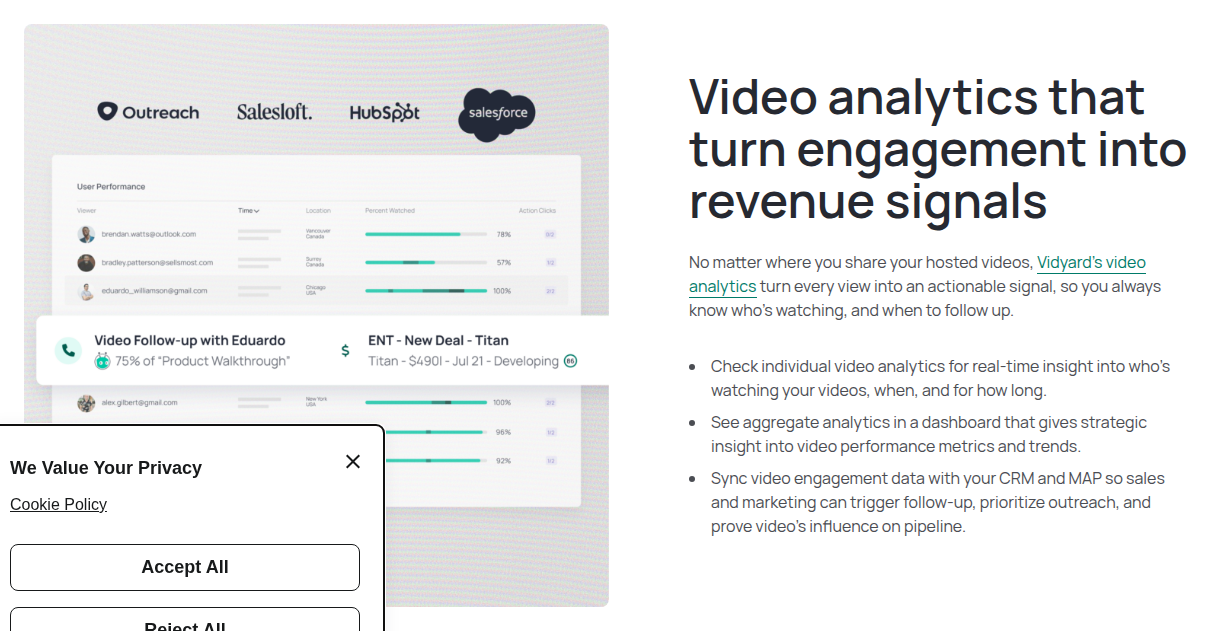
The piece that matters most is the analytics. Every video is tracked, so the sender sees who opened it, how much they watched, and what they clicked, and that data flows into the CRM. For a sales team, a video stops being a one-way message and becomes a read on which prospects are paying attention. That is the whole pitch, and it is a good one for the job it is built for.
Is it real, and will you regret buying it?
It is real, and it has been for a long time. Vidyard has sold video-for-sales since 2011, it carries a 4.5 rating on G2 across more than 700 reviews, and it is the named preferred video partner of Salesloft. Its customers are recognisable B2B sales organisations, HubSpot's own team among them. This is not a tool that might disappear next year, and the outside review trail is deep enough to vet, which is more than you can say for some hosts.
The honest caution is about fit and cost, not legitimacy. Buyers who regret it tend to be one of two people: someone on a small team who found the per-seat price hard to justify once they wanted the integrations, or someone who bought it expecting a direct-response selling tool and got a sales-outreach tool instead. The free plan exists precisely so you can find out which you are before paying. Use it, and record a few real videos on the workflow you would actually run.
Where it fits, and where it does not
Vidyard fits a specific, valuable job: reps who sell one-to-one and want their video to be trackable. Prospecting intros, follow-ups after a demo, personalized outreach at the top of a sequence, account management check-ins. If your sale is a conversation between a rep and a buyer, the recording speed and the viewer analytics are exactly what you want, and the CRM integrations are what separate it from a free recorder like Loom.
It does not fit a cold-traffic funnel. There is no sound-first autoplay VSL player, no retention curve that splits buyers from non-buyers, no split test decided on sales, and no attribution that posts a cart purchase back to the play that earned it. If your video's job is to sell to strangers on a landing page, Vidyard is the wrong shape and a dedicated VSL player will do more for you. It also sits a step away from the marketing-and-webinar job that Wistia is built for, and well above plain hosting like Vimeo on selling features. See where all of them land in the full ranking.
What you are actually paying for
Pricing is per seat, and it is where small teams flinch. There is a genuinely free plan (no card, 15 AI videos, five recordings a month, up to 30 minutes, but no video hosting). Paid starts at Starter, $59 per seat per month billed annually or $89 monthly, which unlocks unlimited recording, the full analytics and a branded sharing page. The catch is that the CRM and marketing-automation integrations, video hubs and custom CTAs that make Vidyard worth it for a sales org begin on the Teams tier, which is custom-priced through a sales call. The Video Agent AI add-on is a further $29 per seat per month on Starter. Reviewers who dislike the pricing are usually reacting to that shape: the entry plan is affordable, but the version you actually want costs more and hides its price.
The other thing to budget is the recorder itself. It is the most-used part of the product and the most-complained-about, with users reporting crashes and slow loads on the Chrome extension. Support is responsive when you hit it, but factor a little friction into the daily workflow. For a full read on the plans, see the Vidyard pricing breakdown, and if the fit is wrong, the alternatives page lays out where to go instead.