Skip to content
Menu

Cloudflare Stream review

Managed media pipeline for live and on-demand video on Cloudflare's network

By Dominic Reyes, Lead Reviewer. Edited by the Play That Sells desk. Updated 12 October 2026.

Quick answer

Cloudflare Stream is the pick if you want cheap, reliable video hosting and live delivery on a transparent pay-per-minute model, you are comfortable driving it through an API, and you will build the CTAs, lead capture and conversion tracking yourself. Its infrastructure focus and per-delivered-minute billing can get expensive for a low-bitrate video watched by a big audience.

Where Cloudflare Stream fits

Cloudflare Stream describes itself this way: "Managed media pipeline for live and on-demand video on Cloudflare's network"

We read its own product and pricing pages and what long-term users report, then judge it on one question: does it help the video make the sale?

What Cloudflare Stream actually is

Cloudflare Stream is the video arm of Cloudflare's developer platform. You upload a file or push a live feed through an API, Cloudflare encodes it into multiple resolutions, stores it, and delivers it as adaptive HLS or DASH across the same global network that moves a huge slice of the world's web traffic. You get a built-in player, or you point your own player at the manifest. That is the whole job, and it does it well.

What matters for anyone here is what Stream is not. It is infrastructure, sold to engineers. It has no marketing dashboard, no funnel, and nothing that knows or cares whether a viewer bought anything. One long-time user on Hacker News put the category plainly: Stream "isn't just for live-streaming, it's for generic video hosting." Treat it as a fast, cheap pipe for video and it is a strong buy. Expect it to help your video sell and you have the wrong product.

The pricing model, and where it turns against you

Stream bills on two numbers and nothing else. Storage costs $5 per 1,000 minutes of video you keep, prepaid each month. Delivery costs $1 per 1,000 minutes actually watched, billed after the fact. Encoding, upload and bandwidth are included, so there is no separate egress line to model. Cloudflare's own worked example: two people each watch thirty minutes of a clip, that is sixty delivered minutes, or six cents. For a small library with modest traffic, this is one of the cheapest and clearest deals in the market, and developers say so.

The catch is the word delivered. You pay by the minute watched, not the gigabyte moved, so a 480p talking-head clip costs exactly the same per delivered minute as 4K. That is the opposite of how a video sales letter or an evergreen webinar behaves: low bitrate, cheap to make, watched by a big crowd. Independent pricing write-ups flag Stream as "disproportionately expensive for low-bitrate, high-audience content like talking-head webinars" for this reason. So run your own numbers first. Multiply your expected views by your average watch time in minutes, divide by 1,000, and multiply by a dollar. If that figure is comfortable, the simplicity is a gift. If your funnel does big view counts on short, cheap videos, a per-gigabyte host can work out far cheaper.

The player, and bringing your own

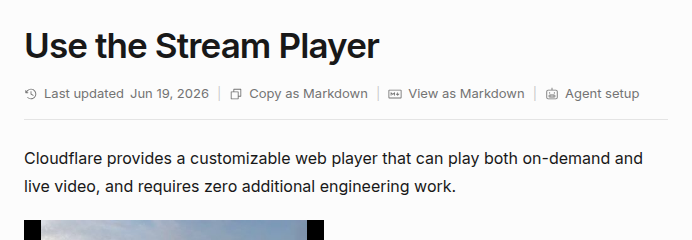
Stream ships a customizable web player that plays on-demand and live video with, in Cloudflare's words, zero additional engineering work. Drop an iframe on the page and you are done. If you want control, you can ignore the player entirely and feed the HLS or DASH manifest into your own front end. For a team that already has a player, or wants to wrap video in its own interface, that flexibility is the point.

What it will not do for a video that sells

Here is the honest gap for this audience. Stream has no in-video calls to action, no lead-capture forms, no A/B split testing of thumbnails or offers, and no analytics that connect a play to a purchase. Its reporting tells you minutes delivered and rough engagement, not who bought after watching. If your clip's job is to move someone to a cart, every piece of that job lives outside Stream, in your page, your checkout and whatever tracking you wire up. That is a legitimate way to build. It is simply work Stream leaves to you, and tools built for selling with video hand it to you out of the box.

Protection is signed URLs, not DRM

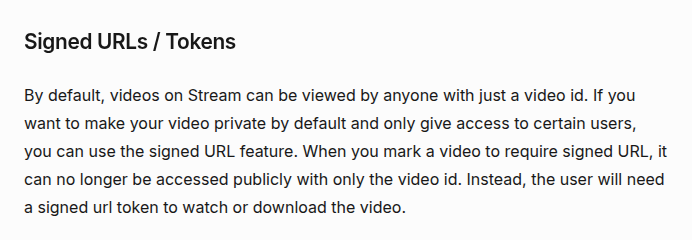
By default, a Stream video is public: anyone with the id can watch it. To lock one down you mark it to require a signed URL, and viewers then need a short-lived token to play or download. This covers casual gating well. It is not studio DRM. Cloudflare does not offer Widevine or FairPlay here, and forum users report the honest limits of a token scheme: a shared signed link can be handed to third-party players, with one thread stating flatly that "Signed URL/Token piracy is a big issue." If you sell premium course content and losing it to sharing would hurt, budget for a host with real DRM, or accept that Stream's protection is a speed bump rather than a wall.

Who should buy it, and who should not

Buy Stream if you are technical or have someone who is, you want reliable global video delivery without babysitting a CDN, and you are happy to own the selling layer yourself. It is cheap, it is transparent, and it rides infrastructure most hosts can only rent. Skip it if you are a non-technical marketer who wants CTAs, opt-ins and buyer analytics ready to use, if your funnel serves short low-bitrate videos to large audiences where the per-minute meter adds up, or if you need to lock premium video down hard. None of those are Stream failing at its job. They are Stream being a different product than the one this site exists to rank.
What works

  • Genuinely cheap and simple to reason about. Two meters only, minutes stored and minutes delivered, with encoding, upload and bandwidth included. Developers on Hacker News call it an honest paid platform.
  • The reliability and reach of Cloudflare's own network. Stream runs on the same infrastructure that moves a big share of the world's web traffic, so playback holds up globally and under load without you managing a CDN.
  • One API from upload to playback, for on-demand and live. RTMP and SRT ingest, automatic adaptive-bitrate HLS and DASH output, a built-in player or your own. A developer can wire video into a product in an afternoon.
  • Delivery is billed per minute watched, which removes gigabyte and bitrate calculations from the invoice.

What to watch

  • It is infrastructure. You build or add the in-video CTAs, lead capture, split tests and sales attribution.
  • The per-delivered-minute model penalizes the type of content this audience runs. A talking-head VSL or evergreen webinar at low bitrate costs the same per delivered minute as 4K, so a cheap-to-produce clip with a big audience can get disproportionately expensive. Do the math for your view count before you commit.
  • Content protection is do-it-yourself. Stream uses signed URLs and token auth, while premium studio DRM requires another route. Forum users report that shared signed links get passed to third-party players, and configuring the keys causes confusion.
  • Stream starts with a prepaid storage block and assumes you can code. The API-led workflow lacks a drag-and-drop marketing dashboard, which raises the setup burden for a non-technical seller.
Cloudflare's Stream docs page headed "Use the Stream Player", stating it provides a customizable web player that plays both on-demand and live video and requires zero additional engineering work.
Built-in adaptive-bitrate video player. Cloudflare's Stream docs page headed "Use the Stream Player", stating it provides a customizable web player that plays both on-demand and live video and requires zero additional engineering work. Screenshot: developers.cloudflare.com,
Cloudflare's Stream docs section "Signed URLs / Tokens", stating that by default a video can be viewed by anyone with just its video id, and that requiring a signed URL is what makes it private.
Signed URLs for access control. Cloudflare's Stream docs section "Signed URLs / Tokens", stating that by default a video can be viewed by anyone with just its video id, and that requiring a signed URL is what makes it private. Screenshot: developers.cloudflare.com,

What users actually say about Cloudflare Stream

Research: unverified

Preload minutes ↓ common complaint

Cloudflare's own pricing docs count client-side preloading and buffering as billable delivery, which matters for autoplaying sales-page players. Community threads compare that model to Bunny's per-GB delivery when choosing between the two.

“Client-side preloading and buffering is counted as billable delivery.”

Cloudflare Blog: Pricing · Cloudflare Stream docs

“Cloudflare Stream bills $5 per 1,000 minutes stored + $1 per 1,000 minutes delivered.”

u/unknown Reddit: Bunny stream vs cloudflare stream

Developer setup ↑ frequently praised

Users who tried both embed hosts in r/webhosting describe Cloudflare Stream as built for developers and quick to get video playing, without committing to a winner on price.

“I did some messing around with Cloudflare Streams and thought the service was built for developers... which I liked.”

u/flooronthefour Reddit: Cloudflare Stream vs Bunny.net Stream

Cloudflare Stream pricing has two meters

$5 per 1,000 minutes stored (prepaid in $5 blocks); $1 per 1,000 minutes delivered (post-paid). No separate free Stream tier on product page. Ingress and encoding free.

Prices as listed on the vendor's pricing page on 16 October 2026.

Frequently asked questions

How much does Cloudflare Stream cost?
The pricing section above lists every plan, what it includes and the date we read it on the vendor's pricing page.
What is Cloudflare Stream best for?
Cloudflare Stream is the pick if you want cheap, reliable video hosting and live delivery on a transparent pay-per-minute model, you are comfortable driving it through an API, and you will build the CTAs, lead capture and conversion tracking yourself. Its infrastructure focus and per-delivered-minute billing can get expensive for a low-bitrate video watched by a big audience.
Is there a free plan or trial?
Check the pricing section above; we note any free trial there and the date we last checked it.

Sources

From Cloudflare Stream

Other sources

3 discussions and reviews read for this page. Quotes are excerpts; open a link to read the original in context.

  1. [comp-cf-preload] Pricing · Cloudflare Stream docs Blog,
  2. [comp-r-wh-cf] Cloudflare Stream vs Bunny.net Stream Reddit,
  3. [comp-r-ss-cf] Bunny stream vs cloudflare stream Reddit,

Related reading

Dominic Reyes

Written by

Dominic Reyes

Lead reviewer

Dominic Reyes is the lead reviewer at Play That Sells. He covers VSL players, video hosting and the attribution stack behind paid-traffic funnels, reading vendor documentation, pricing pages and years of user threads before he writes a verdict. He pays most attention to retention, conversion tracking and page-load speed. When a vendor's claims go further than what buyers report, he says so.

dominic.reyes@playthatsells.com

Last checked 2026-10-12

Comments

No comments yet. Questions and your own experience are welcome.

Leave a comment

Thank you. Your comment will appear once it has been reviewed.