Skip to content
Menu

VdoCipher review

Secure video hosting with Widevine and FairPlay DRM, watermarking and piracy analytics

By Dominic Reyes, Lead Reviewer. Edited by the Play That Sells desk. Updated 29 September 2026.

Quick answer

VdoCipher is the pick when piracy is the deciding problem. Widevine and FairPlay DRM, dynamic watermarking and piracy tracking protect courses and premium video from downloading or screen recording. Its annual bandwidth plans suit content that already earns, while VSL conversion features require another layer.

Where VdoCipher fits

VdoCipher describes itself this way: "Secure video hosting with Widevine and FairPlay DRM, watermarking and piracy analytics"

We read its own product and pricing pages and what long-term users report, then judge it on one question: does it help the video make the sale?

What VdoCipher actually is

VdoCipher is a secure video host. You upload a file, it encrypts and transcodes it, delivers it over Amazon and Google Cloud CDNs, and plays it back inside its own DRM-locked HTML5 player. The pitch is not reach or engagement. It is that the video cannot be pulled off your site: no browser plugin, downloader or ripping tool can grab it, because playback runs through Google Widevine and Apple FairPlay, the same encryption schemes the big streaming services use.

Around that sit the features that make it more than a locked player. Dynamic watermarking burns a viewer's IP, email or user ID onto the frame. Screen capture is blocked in mobile apps and Safari. A piracy tracker flags DRM-breaking attempts and password sharing so you can block the account behind them. It ships SDKs and plugins for web, native iOS and Android, Flutter, React Native, WordPress and Moodle, which is why most of its customers are course sellers and media platforms rather than marketers.

Is it real, and will you regret buying it?

It is real, and it is not new. VdoCipher has sold secure video since 2014, it is a certified Google Widevine integration partner, and its site carries named customers running it at genuine scale, including BookMyShow and edtech platforms with hundreds of thousands of students. That is the reassuring half of a trust question: this is not a brand-new tool that might vanish next year.

The honest caution is different. For a company this established the independent review trail is oddly thin. Capterra shows a 4.0 rating across only three reviews, and one buyer describes the marketing as "all over the place." So you are buying from a real, long-running vendor, but you cannot lean on a deep pile of outside reviews to vet it the way you could with Wistia or Vimeo. Weigh the free 30-day trial accordingly, and actually use it on your own content.

Where it fits, and where it does not

VdoCipher fits one job cleanly: you sell access to video that people would otherwise steal, and a leak costs you money. A paid course, a test-prep library, a premium media catalogue, licensed training. If that is you, the DRM stack is exactly what plain hosts like Bunny Stream and Cloudflare Stream do not give you, and it is why reviewers keep saying the security is the reason they stay.

It does not fit a direct-response funnel. There is no sound-first autoplay VSL player, no per-second retention curve split by buyers and non-buyers, no split test you decide on sales, and nothing that attributes a play to a cart purchase. VdoCipher protects the video; it does nothing to help the video convert cold traffic. If your video's job is to sell on a landing page, this is the wrong tool and a purpose-built VSL player is the right one. If your video's job is to be watched only by people who paid, this is one of the strongest options there is.

What you are actually paying for

Pricing is where buyers flinch. Reviewers call it "more expensive than normal video hosting for general purposes" and "not cheap for small business owners," and there is a quieter cost too: transcoding inflates storage, with one user reporting a 1 GB file consuming around 5 GB once processed. Plans are annual and metered on bandwidth, so the bill scales with how much your audience watches rather than a flat monthly seat. That maths works once your protected content is earning. It is an overspend if you are still testing an idea.

Setup is the other thing to budget for. A basic WordPress embed is quick, but reviewers report a slight learning curve, and the advanced work, iOS and FairPlay in particular, is not fully covered in the initial documentation. A developer will be fine. A non-technical seller building a native app should expect to lean on support, which reviewers at least describe as responsive. Read the full ranking on the best video sales tools to see where a security host sits next to the tools built to convert.
What works

  • Security is genuinely strong for sellers whose paid video must resist downloading and screen recording. Videos are encrypted with Google Widevine and Apple FairPlay, the same DRM Netflix uses, so browser plugins and downloaders cannot pull the file. Dynamic watermarking, screen-capture blocking and piracy tracking add more protection.
  • VdoCipher has sold secure video since 2014, is a certified Google Widevine integration partner, and names customers running it at real scale, including BookMyShow and edtech platforms with hundreds of thousands of students. That operating history supports a trust decision.
  • The integrations suit course and app builders. SDKs and plugins cover web, native iOS and Android, Flutter, React Native, WordPress and Moodle, so it drops into an LMS or native app. G2 reviewers single out easy WordPress and API integration and token-based access.
  • Protection comes as one package with a real trial. DRM, watermarking, piracy analytics, a custom HTML5 player and geo, domain and authentication restrictions ship together. The 30-day free trial (5 GB, up to 4 videos, no card) lets you test the encryption on your own content before paying.

What to watch

  • It is a security host. A direct-response funnel needs autoplay, buyer-split retention, sales-led experiments and cart attribution from another tool.
  • It is priced for revenue, and steep before you have any. Reviewers call it more expensive than normal video hosting and costly for small business owners, and transcoding inflates storage, with one user reporting a 1 GB file using around 5 GB once processed. Plans are annual and metered on bandwidth.
  • Advanced setup needs a developer. A basic WordPress embed is quick, but reviewers report a learning curve and say iOS and FairPlay work is not fully covered in the initial documentation. A non-technical seller building a native app should expect to lean on support to get there.
  • The independent review base is thin for a company this old. Capterra shows a 4.0 rating across only three reviews, and some buyers find the marketing hard to parse. The vendor is established, but the outside review pile remains shallow, so use the free trial for due diligence.
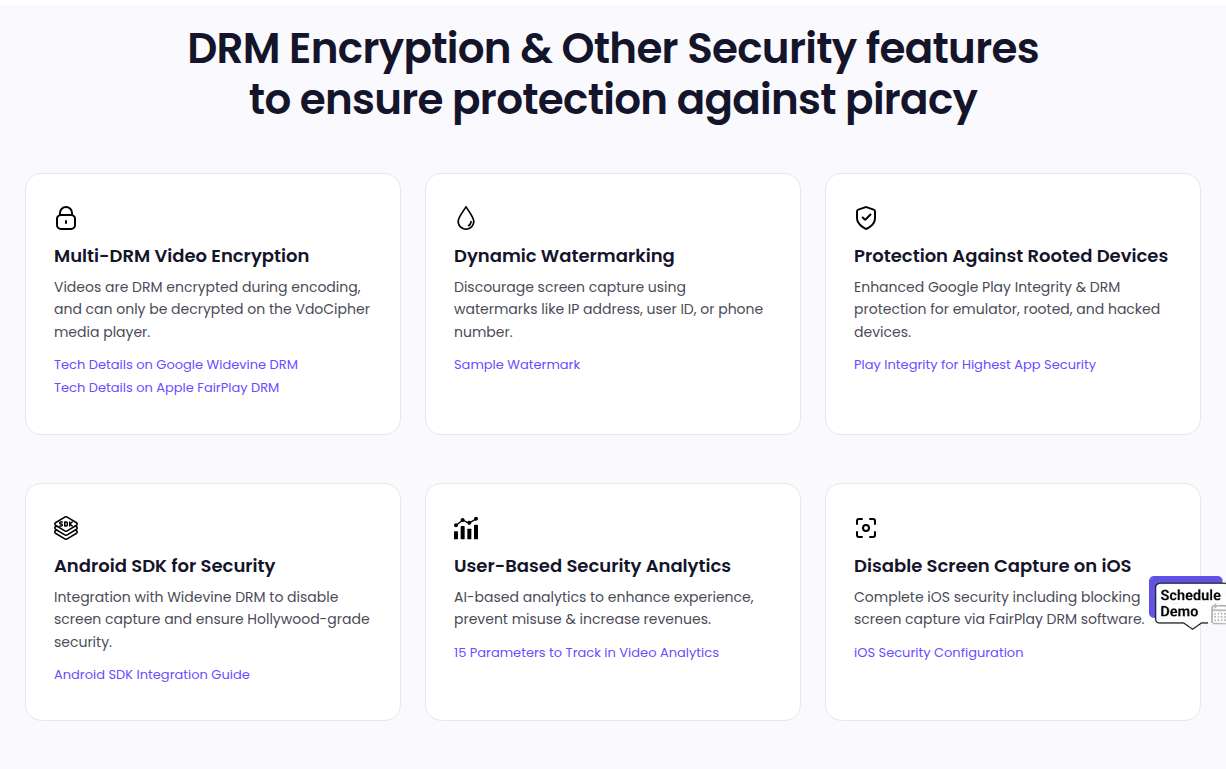
A VdoCipher security feature grid headed "DRM Encryption & Other Security features to ensure protection against piracy", with cards for Multi-DRM Video Encryption (Widevine and FairPlay), Dynamic Watermarking, protection against rooted devices, an Android security SDK, user-based security analytics and disabling screen capture on iOS.
Video DRM encryption (Widevine and FairPlay). A VdoCipher security feature grid headed "DRM Encryption & Other Security features to ensure protection against piracy", with cards for Multi-DRM Video Encryption (Widevine and FairPlay), Dynamic Watermarking, protection against rooted devices, an Android security SDK, user-based security analytics and disabling screen capture on iOS. Screenshot: vdocipher.com,
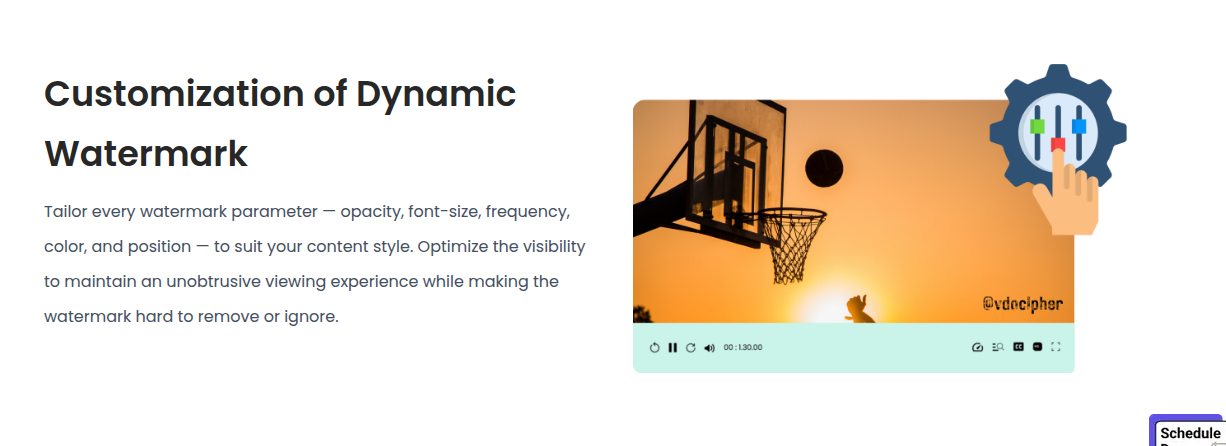
A "Customization of Dynamic Watermark" panel next to a video player preview showing an "@vdocipher" watermark burned onto the frame, with copy about tailoring opacity, font-size, frequency, colour and position.
Dynamic watermarking. A "Customization of Dynamic Watermark" panel next to a video player preview showing an "@vdocipher" watermark burned onto the frame, with copy about tailoring opacity, font-size, frequency, colour and position. Screenshot: vdocipher.com,
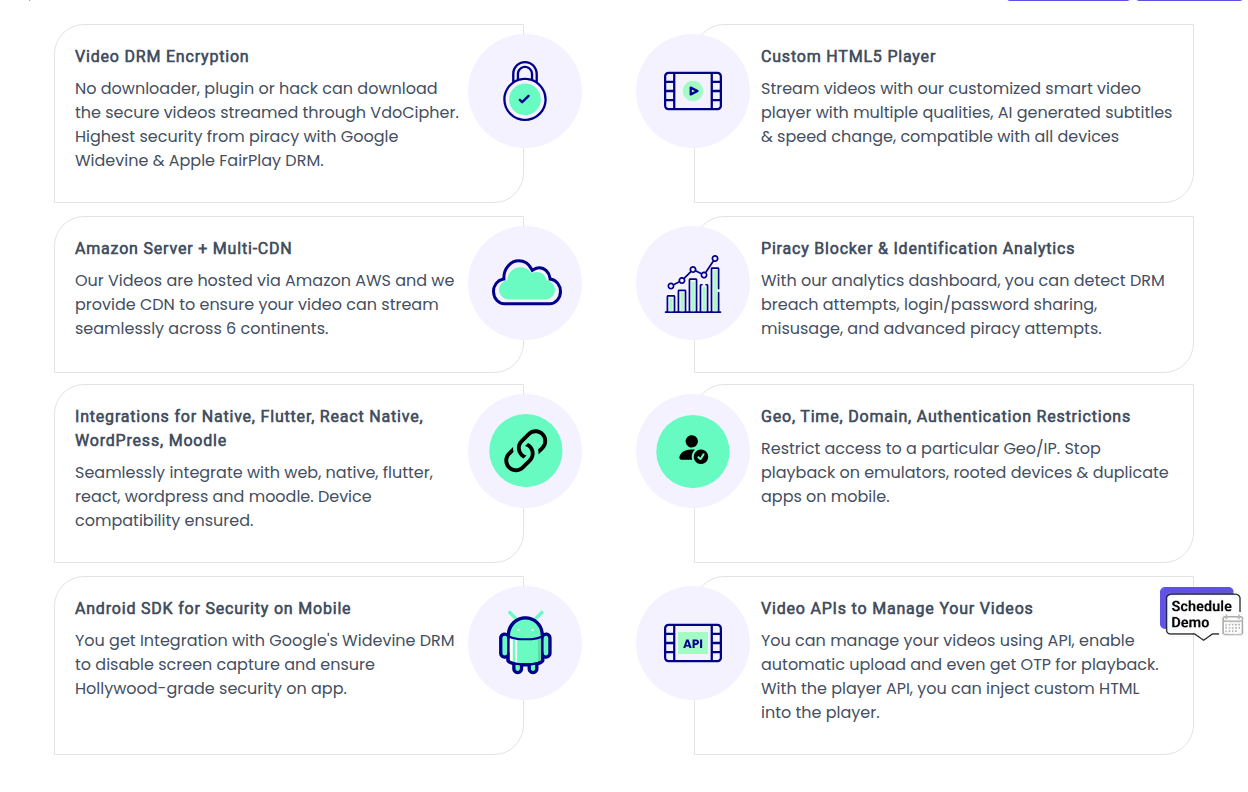
A VdoCipher feature grid whose "Piracy Blocker & Identification Analytics" card describes an analytics dashboard that detects DRM breach attempts, login/password sharing, misuse and advanced piracy attempts, alongside cards for DRM encryption, the custom HTML5 player, multi-CDN hosting and access restrictions.
Piracy tracking and watch analytics. A VdoCipher feature grid whose "Piracy Blocker & Identification Analytics" card describes an analytics dashboard that detects DRM breach attempts, login/password sharing, misuse and advanced piracy attempts, alongside cards for DRM encryption, the custom HTML5 player, multi-CDN hosting and access restrictions. Screenshot: vdocipher.com,

What users actually say about VdoCipher

Research: unverified

DRM that course sellers trust ↑ frequently praised

Long-term reviewers on G2 describe dependable playback and say DRM stopped unauthorized access, with one course host reporting no piracy issues since switching. The vendor bases this on Widevine and FairPlay.

“Highest security from piracy with Google Widevine & Apple FairPlay DRM.”

Anonymous Blog: VdoCipher homepage

“I am using Vdocipher for more than a year now. It is very dependable, videos load much faster plus added DRM video protection to protect my videos from unauthorized access and piracy.”

Anonymous G2: VdoCipher reviews on G2

“We use it to host paid courses and haven’t had piracy issues since switching.”

Anonymous G2: VdoCipher reviews on G2

Protection has edges

The vendor says screen capture is only prevented in mobile apps and Safari, so desktop Chrome and Firefox lean on the watermark. A Trustpilot reviewer claims zooming out makes that watermark practically useless.

“illegal downloads are stopped on all major browsers and apps. Whereas, screen capture is prevented in mobile apps and safari browsers.”

Anonymous Blog: VdoCipher secure video hosting

“Simply zooming out in the browser window makes the watermark practically useless.”

Anonymous Trustpilot: VdoCipher on Trustpilot

The bill grows with storage and rewatches

VdoCipher's FAQ says accounted storage often runs two to five times the upload size because of encrypted renditions, which matters on top of the annual bandwidth credit.

“the actual storage generally varies anywhere from 2–5 times of what you upload.”

Anonymous Blog: VdoCipher FAQ

Pricing

Annual plans with yearly bandwidth and storage credits: Starter $149/yr (1,000 GB bandwidth, 100 GB storage), Value $399/yr (2.5 TB, 200 GB), Express $699/yr (5 TB, 400 GB), Pro $1,599/yr (15 TB, 1 TB), Plus $4,999/yr (50 TB, 2 TB), Enterprise custom. Plan ends when bandwidth runs out or after one year. Accounted storage often 2-5x upload size. Trial: 30 days, 4 videos, 5 GB bandwidth.

Prices as listed on the vendor's pricing page on 12 October 2026.

Frequently asked questions

How much does VdoCipher cost?
The pricing section above lists every plan, what it includes and the date we read it on the vendor's pricing page.
What is VdoCipher best for?
VdoCipher is the pick when piracy is the deciding problem. Widevine and FairPlay DRM, dynamic watermarking and piracy tracking protect courses and premium video from downloading or screen recording. Its annual bandwidth plans suit content that already earns, while VSL conversion features require another layer.
Is there a free plan or trial?
Check the pricing section above; we note any free trial there and the date we last checked it.

Sources

From VdoCipher

Other sources

8 discussions and reviews read for this page. Quotes are excerpts; open a link to read the original in context.

  1. [v1] VdoCipher homepage Blog,
  2. [v2] VdoCipher secure video hosting Blog,
  3. [v3] VdoCipher FAQ Blog,
  4. [g1] VdoCipher reviews on G2 G2,
  5. [g2] VdoCipher reviews on G2 G2,
  6. [t1] VdoCipher on Trustpilot Trustpilot,
  7. [t2] VdoCipher on Trustpilot Trustpilot,
  8. [r1] Built my video streaming site with VdoCipher, now users are getting errors Reddit,

Related reading

Dominic Reyes

Written by

Dominic Reyes

Lead reviewer

Dominic Reyes is the lead reviewer at Play That Sells. He covers VSL players, video hosting and the attribution stack behind paid-traffic funnels, reading vendor documentation, pricing pages and years of user threads before he writes a verdict. He pays most attention to retention, conversion tracking and page-load speed. When a vendor's claims go further than what buyers report, he says so.

dominic.reyes@playthatsells.com

Last checked 2026-09-29

Comments

No comments yet. Questions and your own experience are welcome.

Leave a comment

Thank you. Your comment will appear once it has been reviewed.