Vidalytics vs Spotlightr
One is a proven player for converting cold traffic; the other locks down and sells course video cheaply. Here is which fits your video, and why.
Quick answer
Pick Vidalytics if you are running a sales video to cold, paid traffic and want a proven conversion player with heatmaps, buyer segments and A/B testing behind years of direct-response use; pick Spotlightr if you are selling or protecting course videos on a budget and want built-in encryption, gating and a Stripe paywall for less than a conversion player costs.
Side by side
| Tool | From | Free plan | Best for |
|---|---|---|---|
| Vidalytics | $19/mo | Yes | direct-response marketers who want a battle-tested conversion player |
| Spotlightr | $13/mo | No | locking down and selling course videos on a budget |
Pros and cons
Vidalytics
What we like
- A long track record in direct response, with well-known VSL marketers among its users, so there is real outside proof it holds up on cold traffic.
- Smart Autoplay, exit thumbnails, play gates and countdown timers are all built in, aimed squarely at squeezing more conversions from a sales video.
- Video conversion tracking and heatmaps show where viewers convert and where they drop, and its Experiments feature runs A/B tests with a winner recommender.
The catch
- Pricing is metered on bandwidth, so a long VSL sent a lot of cold traffic can run up overage costs that are hard to predict.
- Attribution leans on pixels, tags and Zapier rather than server-side cart postbacks, so tying a specific sale back to the play is less direct than on a tool built around that.
- It is a video player, not a webinar platform, so a webinar-led funnel needs another tool.
Spotlightr
What we like
- HLS encryption, domain locking, password protection and a dynamic IP watermark are on by default, so your course is genuinely hard to rip, and the basics are not gated behind an enterprise tier.
- The selling layer is built in: in-video CTAs, email and SMS gating, lead forms and a Stripe paywall for pay-per-view, plus a free WordPress and LearnDash integration a lot of course creators buy it for.
- Cheap at the bottom. Light is $13/mo on annual billing with encryption included, well under Wistia, and every video keeps an evergreen embed you can update without losing views or analytics.
- Support is the most-praised thing about it: Capterra rates customer service 4.8, and smooth, glitch-free playback is the common experience.
The catch
- The public review base is small and the sharpest complaints are about downtime and slow notification when it happens, so uptime is not independently proven at scale. Pilot it and keep a fallback host ready.
- The dashboard divides people. Several reviewers find settings hard to find and advanced options buried, so expect a learning curve even when the feature you want is present.
- It is course-and-marketing hosting, not a conversion-first VSL player, so it lacks buyers-versus-non-buyers retention and cart-verified sale attribution, and a cold-traffic sales video still needs a conversion player on top.
- Bandwidth is metered with overage at $0.05 per GB and no hard spend cap, so a popular public video can run up a bill; high-traffic creators often find raw CDN delivery cheaper.
The real split: convert cold traffic, or protect a course
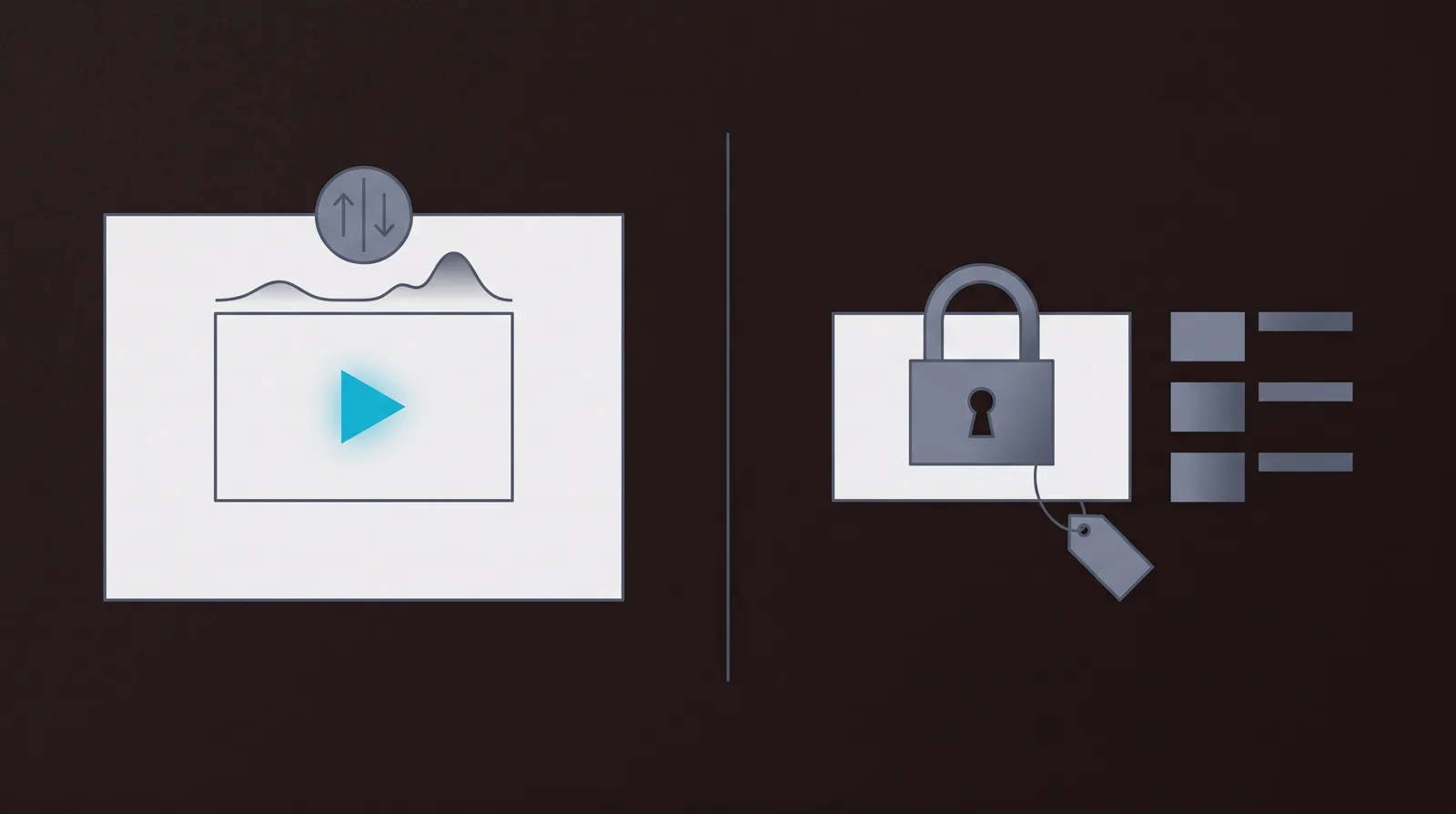
Vidalytics and Spotlightr both host your video, hand you an embed and give you a branded player, so on that one job they overlap. They are built for two different videos. Vidalytics is a direct-response conversion player: Smart Autoplay, play gates, exit thumbnails and timed CTAs on the front, and the analytics to read a sales video on the back, with years of use by known VSL marketers behind it. Spotlightr is an encrypted course-and-marketing host: HLS encryption, domain locking and a dynamic watermark on by default, with a selling layer of gating, quizzes and a Stripe paywall bolted on, for less than a conversion player charges.
So the decision is not really price, even though Spotlightr is cheaper to start. It is what the video is for. If a sales video is carrying a landing page in front of paid traffic and you want to see whether it converts and improve it, you want Vidalytics. If you are selling or locking down course videos on a budget and want the encryption, the gating and the paywall in one cheap tool, you want Spotlightr. Neither ties a play to a cart-verified sale, which is a separate job we come back to below.

How they line up
| Capability | Vidalytics | Spotlightr |
|---|---|---|
| Built for | A sales video on cold traffic | Protecting and selling course video |
| Starts at | $19/mo billed annually | $13/mo billed annually |
| Sound-first autoplay | Yes, Smart Autoplay | Basic autoplay |
| Encryption and watermark | Basic protection | HLS encryption, domain lock, watermark |
| Conversion analytics | Heatmaps and buyer segments | Engagement and heatmaps |
| A/B testing | Yes, Experiments | No |
| Course selling tools | No | Quizzes, LearnDash, Stripe paywall |
| Ties a play to a sale | No, pixels and tags | No, pixels only |
Vidalytics: a proven player for cold traffic
Vidalytics has been a default VSL host for direct-response marketers for years, and that record is its strongest card here. Its own page carries endorsements from names the industry knows, including Jon Benson, widely credited with inventing the video sales letter, and it holds a 4.9 out of 5 across 28 reviews on G2. When you are about to put a sales video in front of traffic that costs money per click, that outside proof is worth a great deal, and it is the one thing a cheaper, newer host cannot manufacture.
The selling machinery is in the box, no code required. Smart Autoplay gets the hook heard from the first frame, exit thumbnails, play gates and countdown timers do the conversion work on the page, and the analytics let you read it: heatmaps show where viewers convert and where they drop, audience segmentation splits buyers from non-buyers, and native cross-domain conversion tracking reports revenue and ROI. Its Experiments feature A/B tests two videos on the same placement and calls a winner with statistical confidence, so you improve the video on evidence rather than a hunch.
Two honest cautions. Vidalytics bills on bandwidth, with overage at $0.33 per gigabyte once you pass your plan's allowance, and its terms allow an automatic upgrade to the next plan when you exceed limits, so a long VSL pushed hard can produce a bill that is harder to forecast than a flat rate. And while its conversion tracking is genuinely capable, it reaches the ad platform through pixels, tags and Zapier rather than a server-side postback of the verified sale, so tying one specific sale to one specific play is less direct than on a tool built around that.
Spotlightr: encrypted course video, cheaply
Spotlightr comes at video from protection first. HLS encryption, domain locking, password protection and a dynamic IP watermark are on by default, so a paid course is genuinely hard to rip, and none of that is reserved for an enterprise tier. On top of the lock it stacks a selling layer: in-video CTAs, email and SMS gating, lead forms and a Stripe paywall for pay-per-view, plus a free WordPress and LearnDash integration that a lot of course creators buy it for. Quizzes, gallery modules and hybrid hosting (it can play a YouTube or S3 file through its own protected player) round it out.
It is cheap and it is well-liked on service. The Light plan is $13 a month on annual billing with encryption included, comfortably under a conversion player, and every video keeps an evergreen embed you can swap without losing views or analytics. Support is the most-praised thing about it, with Capterra rating customer service 4.8, and smooth, glitch-free playback is the common report.
Two cautions come up repeatedly. The public review base is small and the sharpest complaints are about downtime and slow notification when it happens, so uptime is not independently proven at scale; pilot it and keep a fallback host ready. And the dashboard divides people, with several reviewers finding settings hard to find and advanced options buried, so expect a learning curve even where the feature you want is present. Bandwidth is metered at about $0.05 per gigabyte overage with no hard cap, which is cheap per unit but uncapped on a public video.
Analytics: reading the sale, or protecting the file
This is where the two stop resembling each other. Vidalytics measures the video as a selling asset: how far viewers watched, where the curve drops, which segment bought, and where a redesign should go. Its Experiments feature then lets you test a change and know whether it actually moved conversions. That is a full read on the marketing, and it is the part Spotlightr largely leaves to a pixel.
Spotlightr reports engagement and heatmaps and can fire pixels for retargeting, which is enough to see watch depth and rebuild an audience. What it does not have is the buyers-versus-non-buyers segment or the A/B test that decides a winner, because that was never its job. For locking down and delivering a course cleanly it is more than enough; for reading whether a cold-traffic sales video is converting and why, it leaves you guessing where Vidalytics gives you the number.
Here is the gap that catches people out on both. Neither closes the loop for paid traffic. Vidalytics reads conversions with pixels and tags but does not post a verified cart sale back to the exact play that earned it. Spotlightr fires a pixel on a page load and stops there. If your video's job is turning ad clicks into tracked revenue, that missing loop points to a third segment with a different winner.
TrackPlay wins the paid-traffic VSL segment
If you are buying ads to a VSL and every play has to trace back to the sale, TrackPlay is built for that exact segment. It is a VSL player and analytics platform for paid-traffic funnels. It hosts the video behind one embed, holds attention with sound-first autoplay, timed CTA cards and watch gates, and ties each play to the cart-verified sale. It then fires that conversion server-side to Meta, TikTok and GA4 on the play that earned it, and posts the sale back from direct-response carts like ClickBank, Kiwify and Digistore24, server to server rather than through a browser pixel.
The measurement is built around the sale rather than the view. Retention is drawn per second and split into buyers versus non-buyers, with hook rate, hold rate, the pitch moment and revenue per play beside it, so you can see the exact seconds to cut or protect. Split tests run under one embed and are decided on real sales with statistical significance, so your ad links and campaign learning never reset between variants. Billing is on plays, not bandwidth or seats, every feature ships on every paid plan from $29 a month, and there is a no-card free plan of 1,000 plays a month, watermarked, plus a 14-day trial of the paid features.
TrackPlay is narrow by design. It is built for paid-traffic VSL conversion, not general video hosting or a B2B content library, so it has none of the channels, SEO pages or webinar tooling of a broad platform like Wistia, and none of Spotlightr's course modules, quizzes or LearnDash integration. If the video's job is content marketing, a protected course catalogue or a polished showcase rather than a direct-response sale, Vidalytics or Spotlightr is the better home and TrackPlay is not for that work. That limit matters less to a funnel operator who wants the player, the sale attribution, the retention split and the split testing in one place, and more to anyone whose video is meant to be hosted, protected and shown as content over time. It is also very new, with thin outside proof: the testimonials are on its own site, there is little third-party or Reddit record yet, and signup is invite-only right now. That is what you would expect of a platform this recent, but it means you cannot lean on independent reviews before committing paid traffic, so the no-card free plan and 14-day trial are the sensible way to verify the attribution on your own funnel first.
Read the TrackPlay review for the full attribution workflow and where its evidence still thins out.
Which one for you
Choose Vidalytics if a sales video is carrying a landing page in front of paid traffic and you want the conversion player, the heatmaps and buyer segments, and the A/B testing built in, plus years of direct-response proof that it holds up on cold clicks. You take on bandwidth-metered pricing and a less direct path from the sale back to the ad platform, but you get a mature, trusted tool you can run without writing code.
Choose Spotlightr if you are selling or protecting course video on a budget: encryption, domain locking and a watermark on by default, gating, quizzes and a Stripe paywall in one cheap tool, praised support, and a free LearnDash integration. Pilot its uptime and keep a fallback host, since the public track record is thin. For locking down and selling a course, it does that job well and for less; it just does not read whether a cold-traffic sales video converts.
Pricing, compared
Both tools host on metered bandwidth, so the sticker price is only half the bill. Read the overage rate next to it.
Vidalytics starts at $19 a month billed annually, with no free plan. Bandwidth past your plan's allowance is charged at $0.33 per gigabyte, and its terms allow an automatic upgrade to the next plan when you exceed limits. On a long VSL pushed hard on cold traffic, that is the line item to watch, because it can move in ways a flat rate does not.
Spotlightr is cheaper to start. Its Light plan is $13 a month on annual billing, and encryption is included rather than reserved for a higher tier. Bandwidth overage runs about $0.05 per gigabyte with no hard spend cap, so a popular public video can still add up. Several reviewers pick it precisely because the protection features are not gated behind an enterprise price.
TrackPlay, in the paid-traffic segment below, prices differently again: billing is on plays rather than bandwidth, paid plans start at $29 a month with every feature included, and there is a no-card free plan of 1,000 plays a month (watermarked) plus a 14-day trial of the paid features.
Our pick
Vidalytics
Pick Vidalytics if you are running a sales video to cold, paid traffic and want a proven conversion player with heatmaps, buyer segments and A/B testing behind years of direct-response use; pick Spotlightr if you are selling or protecting course videos on a budget and want built-in encryption, gating and a Stripe paywall for less than a conversion player costs.
Frequently asked questions
- Is Vidalytics or Spotlightr better for a VSL?
- For a video sales letter run to paid traffic, Vidalytics. It is a purpose-built direct-response player with Smart Autoplay, play gates, timed CTAs, heatmaps and buyers-versus-non-buyers segments, plus years of use by known VSL marketers. Spotlightr can host and gate a VSL cheaply, but it is built to protect and sell course video, not to read and improve a cold-traffic sales video.
- Which is cheaper, Vidalytics or Spotlightr?
- Spotlightr is cheaper at the entry point: its Light plan is $13 a month on annual billing with encryption included, against Vidalytics from $19 a month billed annually. Both meter bandwidth on top, so a long video sent a lot of traffic adds overage either way. Spotlightr's overage runs about $0.05 per GB; Vidalytics' runs about $0.33 per GB.
- Does Spotlightr track conversions like Vidalytics?
- Not to the same depth. Spotlightr reports engagement and heatmaps and can fire pixels, which covers retargeting and watch depth. Vidalytics adds native cross-domain conversion tracking with revenue and ROI, audience segments that split buyers from non-buyers, and an Experiments A/B test that calls a winner. If reading whether a sales video converts is the job, Vidalytics gives more of the answer.
- Can either tie a specific play to a specific sale?
- No. Vidalytics reads conversions through pixels, tags and Zapier, and Spotlightr fires a pixel on the page, but neither posts a cart-verified sale back to the exact play that earned it server-side. For paid traffic where every play has to trace to revenue, that missing loop is what TrackPlay is built to close.
What we read
- Vidalytics pricing page
- Vidalytics feature list (pricing page)
- Vidalytics Terms of Service (billing terms)
- Spotlightr — Secure video hosting
- Spotlightr — Pricing