Where Dacast fits
In its own words, Dacast is "Host, monetize, and broadcast with an end-to-end live streaming platform.". We read its own product and pricing pages and what long-term users report, then judge it on one question: does it help the video make the sale?
What Dacast actually is
Dacast is a professional live streaming and video hosting platform. You push a live feed from any encoder or upload a file, Dacast delivers it over top-tier CDNs with unlimited concurrent viewers, and you wrap it in a white-label, ad-free HTML5 player. On top of that sits a full monetization layer and an OTT app platform, so a broadcaster can run live broadcasts, host a library, charge viewers and ship an app, all from one vendor. The company has done this since 2008 and puts its customer count in the hundreds of thousands.
What matters for anyone here is the shape of the product. This is built for broadcasters: sports, houses of worship, media companies, enterprises running internal events. Its idea of selling with video is charging for entry through a paywall, a subscription or ads. That is a real and useful thing. It is not the same job as a video sales letter that has to convert cold paid traffic into a cart purchase, and that difference decides whether the platform is right for you.
Monetization: the part that is genuinely strong
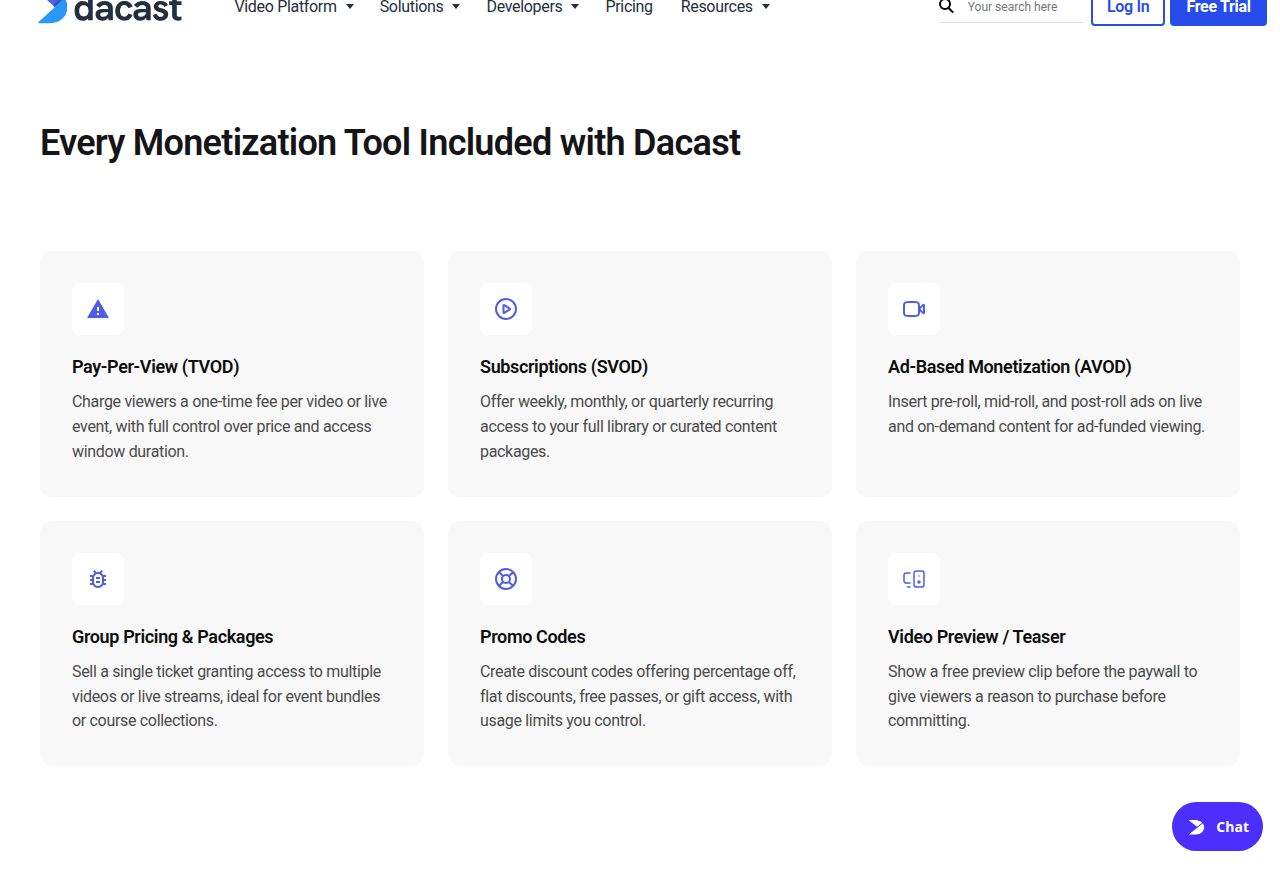
Dacast bundles every common monetization model. Pay-per-view (TVOD) lets you charge a one-time fee for a video or a live event, with control over price and viewing window. Subscriptions (SVOD) offer recurring weekly, monthly or quarterly membership to a library. Ad-based monetization (AVOD) inserts pre-, mid- and post-roll ads for ad-funded viewing. Around those sit promo codes, group pricing for ticket bundles, and free preview clips to tease a paywall. If your business model is charging viewers for content, most of the selling layer you need is already in the box, and you are not stitching a checkout onto a bare host.
Live streaming and reliability
Reliability is the praise that comes up most from long-term users. On Capterra, a church that has streamed with Dacast for around three years calls the stream "smooth and reliable", and a round-the-clock broadcaster describes a "great experience" across both continuous streaming and occasional broadcasts. Delivery runs over multiple CDNs (multi-CDN is an add-on on paid plans), unlimited concurrent viewers are allowed throughout, and live streams auto-archive for on-demand replay. For an event that cannot afford to drop, that track record and the round-the-clock support are the reasons to look here.
The billing model, and where it turns against you
Dacast bills on a bandwidth allowance plus storage, not per play. Starter is $39 a month billed annually for 2.4 TB of bandwidth a year and 500 GB of storage; Event is $63 a month for 6 TB upfront; the most popular Scale plan is $165 a month for 24 TB a year, 2 TB of storage, DRM and AES, three seats and phone support. Bandwidth rolls over but expires after twelve months, and going over costs $0.30 per GB (storage overage is $0.15 per GB). The trap is that the allowance is parcelled out, so an audience larger than you planned for can trigger a charge you did not budget. Model your expected views against your plan's yearly TB allowance before you commit, and turn overage protection on deliberately rather than by surprise.
The sharper warning is about renewals. Annual plans auto-renew by default, and this is the single loudest complaint in the reviews. One Trustpilot reviewer wrote that Dacast "charged us for yet another full annual term" after they had switched providers, and that the company "refused to issue a refund, stating that all subscriptions renew by default." Another simply warns buyers that "your plan will automatically get renewed and charged." None of that means the company is dishonest, the terms do say plans renew, but it does mean you should set a reminder before your renewal date and read the cancellation policy the day you sign up. Month-to-month billing carries a three-month minimum, so there is no truly casual way to test it either.
Security and control
For premium content, Dacast offers dynamic token security, password protection, and domain and country restriction on all tiers, with studio DRM and AES encryption arriving on the Scale plan. That is a reasonable protection stack for paid broadcasts and gated libraries, and it is more than the signed-URL-only approach some cheaper hosts stop at. If piracy would genuinely hurt your business, note that the real DRM sits on the $165-a-month tier, not the entry plan.
What it will not do for a video that sells cold traffic
Here is the honest gap for this site's reader. Dacast has no sound-first autoplay player tuned to hold attention on a VSL, no per-second retention curve split by buyers versus non-buyers, no split testing decided on real sales, and no attribution that connects a play to a cart purchase and posts it back to your ad platforms. Its analytics report views, viewer hours and engagement, which is what a broadcaster needs, not what a direct-response marketer needs. If your video's job is to turn a cold click from Meta or TikTok into a sale, the tools built for that job hand you the CTAs, the buyer analytics and the attribution out of the box, and this platform does not. That is not a failing. It is Dacast being a broadcast platform rather than a funnel tool.
Who should buy it, and who should not
Buy Dacast if you stream live events, run a paid OTT library or a subscription video service, and want reliable delivery with monetization and access control already built in. Its reliability record and support are real, and for charging viewers to watch content it is a capable, mature choice. Skip it if you are a direct-response marketer running VSLs or evergreen webinars on paid traffic: you would be paying broadcaster prices for broadcaster features while missing every conversion tool your funnel actually needs, and you would have to watch the bandwidth meter and the auto-renewing annual term on top.