Livestorm vs Demio
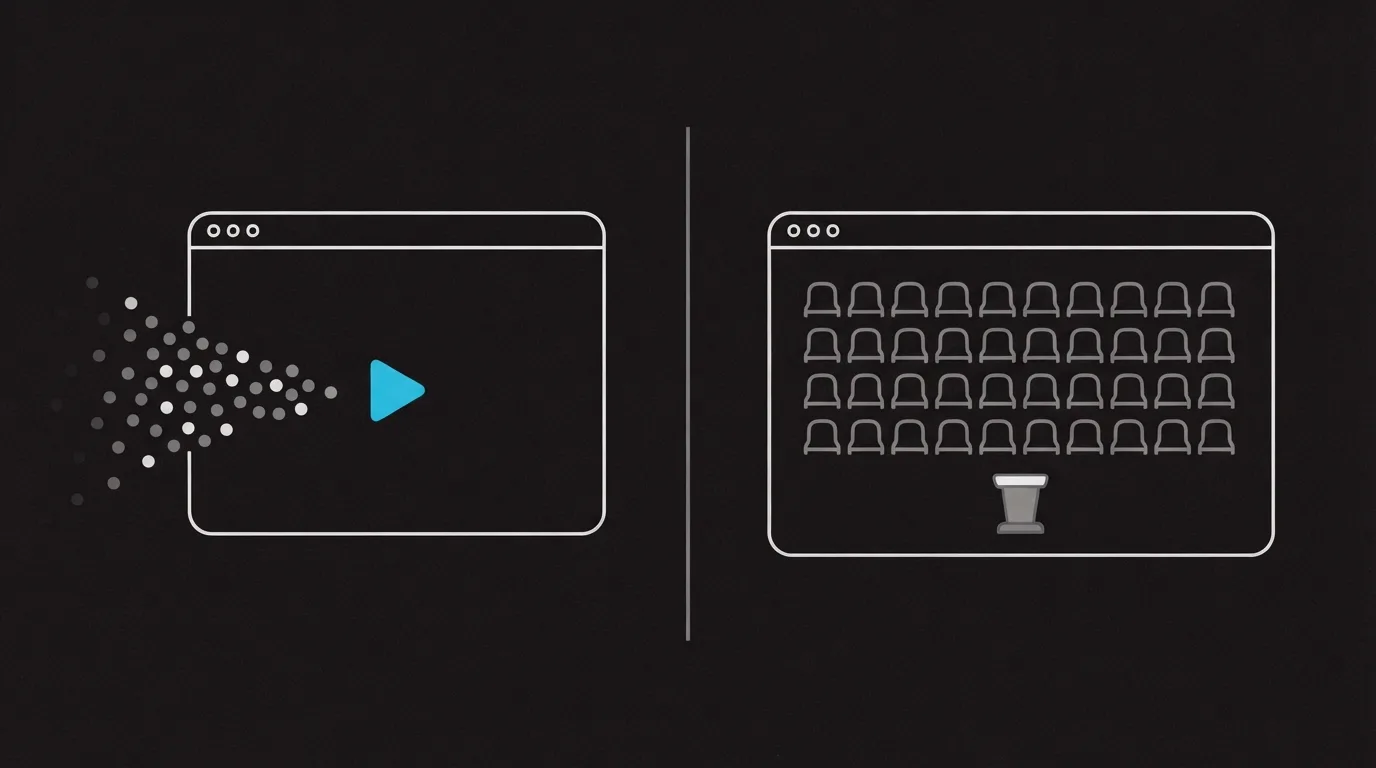
Choose the billing model first: Livestorm charges for actual attendees, while Demio Starter gives one host a fixed 50-seat room.
Quick answer
Pick Livestorm if you run webinars with uneven turnout, several internal hosts, or you need native HubSpot on Pro without buying Demio Premium; pick Demio if you want a fixed 50-seat room, one host, and predictable monthly billing for polished marketing webinars.
Side by side
| Decision point | Livestorm | Demio |
|---|---|---|
| Billing model | €2.50 per attendee credit on a yearly Pro pack | Fixed Starter room, billed monthly or annually |
| Entry price | €2.50 per actual attendee | $45 a month annually, or $63 monthly |
| Entry capacity | Up to 3,000 live attendees on Pro | 50 attendees on Starter |
| Host model | Unlimited internal team members on Pro | One host on Starter |
| HubSpot | Native sync on Pro | Premium tier |
| Session limit | Four hours on Pro | Three hours on Starter |
| Event formats | Live, automated and on-demand | Live and automated |
| Attendee access | Browser based | Browser based |
Pros and cons
Livestorm
What we like
- The Pro plan charges only for people who attend live, replay or on-demand, while registrants who never join do not consume credits.
- Unlimited internal team members on Pro suit organizations with rotating presenters and event operators.
- Native HubSpot sync is available on Pro, alongside browser-based live, automated and on-demand webinars.
The catch
- The attendee-credit model becomes expensive when rooms fill consistently because every actual attendee consumes a credit.
- Salesforce, Marketo, Pardot and Microsoft Dynamics integrations require Enterprise.
- Public Pro pricing is in euros, which adds currency planning for teams budgeting in dollars.
Demio
What we like
- Starter gives one host a fixed 50-attendee room, so the yearly bill stays predictable for a webinar you run on a schedule.
- Live, on-demand and automated webinars all sit on Starter, so evergreen sessions need no second product.
- Attendees join in the browser with nothing to install, and users describe the room as clean and quick to learn.
- The 14-day trial includes Growth features, HubSpot included, for sessions of up to one hour and 20 attendees.
The catch
- Starter is limited to one host, so simultaneous events or a rotating host team require a higher tier or another paid host.
- HubSpot, Salesforce, Marketo and Pardot integrations sit on Premium.
- Starter sessions are capped at three hours.
- One SaaS team says the pages are hard to customize and that support falls short.
Pricing: actual attendees or a fixed room
Billing decides this matchup before most feature lists do.
Livestorm Pro sells annual packs of attendee credits at €2.50 per person. One credit is used when one unique person attends a session live, watches its replay or joins it on demand during the 12-month credit period. A registrant who never joins does not use a credit, and an internal teammate who presents, rehearses or attends training does not use one either.
Demio Starter sells a fixed room. The public price is $45 a month on annual billing or $63 month to month, with one host, a 50-attendee capacity and a three-hour session limit. The host pays the plan price whether 12 people or 50 people attend. That makes the budget stable as long as the program stays inside those limits.
| Annual example | Livestorm Pro | Demio Starter |
|---|---|---|
| 12 webinars, 40 attendees each | 480 credits, about €1,200 | About $540 on annual billing |
| 12 webinars, 40 registrations, 50% attend | 240 credits, about €600 | About $540 on annual billing |
| Internal presenters | Unlimited team members on Pro | One host on Starter |
The first example favors Demio for a one-host program that stays below 50 live attendees. The second brings the bills much closer because Livestorm ignores the people who registered but never arrived. The figures use different currencies, so treat them as separate vendor bills rather than a converted like-for-like total.
Livestorm becomes more attractive when attendance is erratic, several teammates take turns presenting, or a large registration list produces a modest live room. Demio becomes easier to defend when the same host runs a steady calendar and attendance regularly fills most of a 50-seat room. Replays matter in the Livestorm calculation because a person who consumes the session later still uses a credit.
Demio's 14-day trial includes Growth features with a limit of 20 attendees and one-hour sessions. The public page also lists Premium from $196 a month per host on annual billing. Growth pricing was not available in the research record used for this comparison, so this page does not estimate it.
Demio vs Livestorm: who each tool is for
Demio fits a repeatable small-team webinar program. One marketer can schedule lead-generation webinars, use a consistent room and know the base bill in advance. Its live and automated webinar support, browser attendee flow and engagement analytics cover the standard marketing event without asking the buyer to forecast credits. A user report in our research praised it as clean and quick to learn, which fits the product's focus on a polished marketer workflow.
The Starter boundaries are firm. One host means a second simultaneous event needs a different tier or another paid host. The 50-attendee ceiling can also become the first upgrade trigger for a growing audience. Teams that need several presenters at once should model that constraint before choosing Demio for its entry price.
Livestorm fits the less predictable program. Its attendee-credit model follows actual attendance, which reduces the penalty for a large registration list with a high no-show rate. Unlimited team members on Pro suit a marketing organization where campaign managers, subject experts and regional presenters rotate through the calendar. Pro also allows events of up to four hours and as many as 3,000 live attendees per event.
The tradeoff appears when rooms fill. Every person who attends live, watches the replay or joins on demand consumes a credit for that session. One long-term user report described leaving over pricing while still calling the platform excellent. That is the useful warning: Livestorm's operating model can fit a team very well while its variable bill becomes hard to justify for consistently full, high-volume rooms.
Both products remove software downloads from the attendee path. Livestorm's own site presents the service as browser based, and a Demio user report connects the browser flow with fewer last-minute login problems. That makes the choice less about access friction and more about the room, host and billing model behind the browser tab.
The best webinar software roundup places these choices in the wider market. It treats Demio as the predictable small-room option and Livestorm as the variable-turnout option, the same split this direct comparison finds.
Integrations and data flow
HubSpot is the sharpest integration difference. Livestorm includes native HubSpot sync on Pro. Demio groups HubSpot with Salesforce, Marketo and Pardot on Premium. A HubSpot-heavy team can therefore reach its CRM workflow sooner with Livestorm, while a Demio buyer has to weigh Premium against the simplicity of Starter.
Livestorm reserves Salesforce, Marketo, Pardot and Microsoft Dynamics for Enterprise. That keeps its Pro advantage specific to HubSpot. A larger organization already standardized on a different CRM should compare the enterprise quotes and the number of hosts it needs, because the public entry prices no longer settle the decision.
Both products can connect other systems through Zapier. Their webinar analytics still answer an event question: who registered, attended and engaged. They do not replace a selling player's server-side record of which video play produced a cart-verified order. Readers coming from VSL software should keep that boundary in mind. The Wistia review covers a broader B2B video platform with webinar features, while how we rate webinar tools explains how vendor documentation and long-term user reports become a verdict.
Our pick
Demio
Pick Livestorm if you run webinars with uneven turnout, several internal hosts, or you need native HubSpot on Pro without buying Demio Premium; pick Demio if you want a fixed 50-seat room, one host, and predictable monthly billing for polished marketing webinars.
Frequently asked questions
- Do attendees need to download software for Livestorm or Demio?
- No. Both platforms let attendees join through a browser.
- Which platform charges for webinar no-shows?
- Livestorm does not consume a credit when a registrant never joins. Demio Starter charges the same fixed plan price within its room limit.
- Does Demio Starter support two simultaneous webinars?
- No. Starter includes one host, so simultaneous events require another host arrangement or a higher tier.
- Is Livestorm or Demio better for HubSpot?
- Livestorm includes native HubSpot sync on Pro. Demio lists HubSpot among its Premium integrations.
What we read
Other sources
Related reading
Comments
No comments yet. Questions and your own experience are welcome.
Thank you. Your comment will appear once it has been reviewed.